Amelia interviewed by the SCMP on Jewish refugee exhibition at the Goethe-Institut Hong Kong
History Ink’s Dr Amelia Allsop was recently interviewed by SCMP journalist Tamar Herman for her role as co-curator of the exhibit ‘Jewish Life in Germany and Escape Destination Hong Kong’, hosted at the Goethe-Institut Hong Kong.
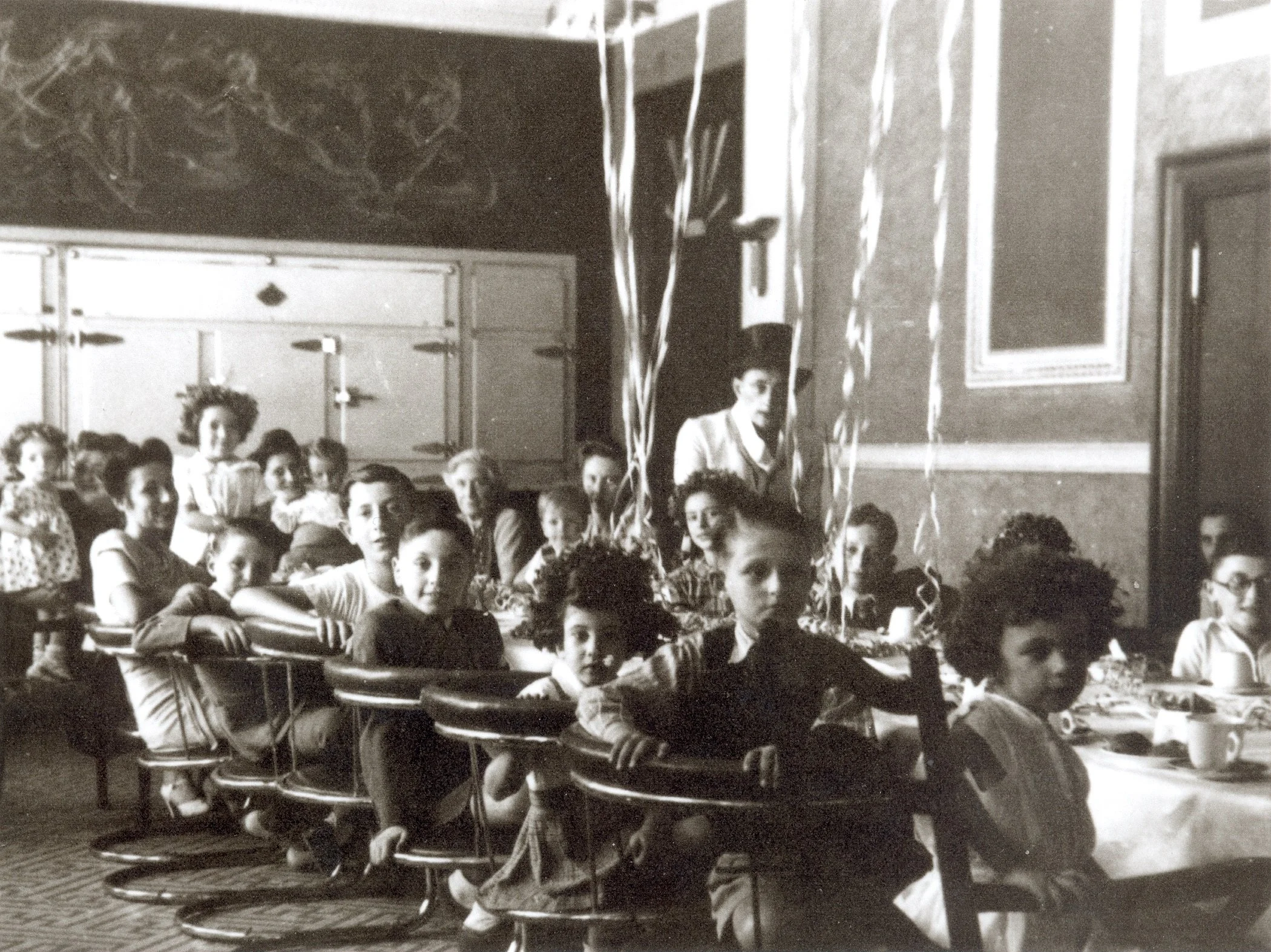
A party for Jewish refugee children at The Peninsula hotel in 1946. Photo: Fred Antman and the Hong Kong Heritage Project
The exhibition opened on November 11 and features a variety of multimedia content and information exploring the lengthy history of Jews in Germany. The event ties into Hong Kong’s history by presenting new research unveiled by Amelia, sponsored by The Hong Kong Heritage Project, which reveals a complicated story surrounding Jews from Germany and Austria fleeing Nazi oppression and coming to Hong Kong.
Amelia curated the Hong Kong part of the exhibit based on research for her doctorate. According to her research, the city was primarily considered a transit hub for European Jews before, during and after the war who were heading to other British colonies, as well as to Australia, the United States and, after its foundation in 1948, Israel.
“Hong Kong was a port of transit for Jewish refugees, a place of short-term settlement, a place of incarceration, internment and banishment, and then post-war it was a place of transmigration,” Allsop says. Many of the earliest German and Austrian Jewish refugees arrived in Hong Kong in 1938 and 1939 as the war was just beginning in Europe. Some had already faced Nazi internment, and were given a rare opportunity to leave the region, an experience which was later phased out of all Nazi concentration camps. But Jewish refugees in Hong Kong faced a variety of difficulties, experiencing discrimination both as refugees and for being German and Austrian nationals, enemies of the state due to the Axis alliance. Many faced internment at La Salle College in Kowloon as enemies of the Allies – alongside Nazi Party members themselves.
Most were forced to leave Hong Kong, with only a handful who were able to get special dispensation permitted to stay. This was often facilitated by the intervention of members of the Kadoorie family – one of the most influential Jewish families in Hong Kong and Shanghai – who spoke up for refugees, especially skilled workers, to the colonial government. In 1940, the colonial government expelled almost all Germans and Austrians from Hong Kong fearing their aiding the Japanese, who would take over Hong Kong in 1941; this included most Jewish refugees, whose only option left was to go to Shanghai, or return to Europe and the likely death that awaited them there. When the Japanese arrived, some of the remaining Jewish refugees fought alongside the British. A small number, as Germans and Austrians, were forced to work for the Japanese.
By the end of the war, most of the Jewish refugees left in Hong Kong had fled to Macau as the situation in Hong Kong worsened. After the war ended in 1945, The Peninsula hotel became a temporary home to Jewish refugees en route to other destinations as they fled the aftermath of the Holocaust.
“As refugees, it wasn’t a linear route to escape,” Allsop says. “It was a back and forth between Shanghai, interned in Hong Kong – it wasn’t an easy life after refugees left. They had to start again, leave behind everything they knew, and then they were uprooted again in Hong Kong.” Another part of the exhibit, a mixed-media installation titled “Qing” by Simon Wachsmuth, explores memory, migration and culture.
Jewish Life in Germany and Escape Destination Hong Kong, Goethe-Institut Hong Kong, Hong Kong Arts Centre. Until Dec 11 2021.