Legacy as Strategy: What is Corporate History Storytelling?
When you tell a story, you spark a connection. That is the power of storytelling.
– Jay O’Callahan
Stories are the engine of human connection – they are, literally, what make the world go round. In the world of marketing, this is not just sentiment, but strategy. Corporate history storytelling is the art of using a company’s unique heritage, whether through milestones, anniversaries or archival social media content, to build a resonant brand. Every organisation, from storied associations to modern agencies, rests upon a foundation of authentic history. A business’s history is a living document that speaks and testifies to its past, while actively shaping its future.
History is the most vital component in corporate branding, the image an organisation presents to the world. It helps tell the story of how an organisation developed from a singular idea and a small group of people into a brand with a distinct personality. The value of corporate storytelling is no better reflected than in Adidas' struggle with its brand identity in the late 1980s.

The Adidas archive, courtesy of Adidas
Adidas’ story is a powerful demonstration of how corporate storytelling can rescue a brand identity. In the late 1980s, the company faced a crisis after rejecting its rich sports heritage to focus on unrelated brand extensions like leisurewear and camping gear. Founder Adi Dassler’s extensive shoe collection and his notebooks—containing 50 years of sketches—were cast into storage. The brand identity, now diluted, left employees confused and corporate strategy unclear, leading to a financial crisis.
It was only when outsiders Peter Moore and Rob Strasser recognised the company was sitting on a "gold mine" of history, that the brand turned around. By uncovering and curating these historical assets, they reminded managers that Adidas’ identity was rooted in Dassler’s philosophy of meeting the needs of athletes, and his obsession with peak athletic performance. This rediscovery inspired the creation of the wildly successful Equipment and Originals lines.
Corporate history storytelling does not just look backwards, but is future-oriented. It keeps the company’s goals in mind and aids in the stability and fortitude of the company. Though Adidas changed ownership thrice during the 1990s, its strategic use of history enabled it to understand its goals for the future. Recovering from near bankruptcy in 1989, sales reached V5.3 billion in 1999 and the company recorded a pretax profit of V398 million.
This is relevant not only to companies with long histories, but also to younger businesses. Power is found in founding stories, which speak to multiple audiences, from shareholders looking for stability to new hires seeking a sense of belonging. According to the Harvard Business Review, when team members understand their group’s history, they see themselves as part of a still-unfolding story larger than themselves. This aids in recruitment and onboarding, as new employees will feel familiar with the company culture and know exactly their organisation’s direction.

The YWCA Gallery in Fort Canning, courtesy of YWCA Singapore
In Singapore, modern corporate storytelling utilises a diverse range of assets, moving beyond dusty ledgers to include oral histories and digital archives. Some recent examples include the pioneering Young Women’s Christian Association (YWCA) in Singapore, which celebrated its 150th anniversary in 2025 with a heritage gallery in Fort Canning.
2025 also saw younger entities such as the Defence, Science & Technology Agency (DSTA) commemorate their 25th anniversary with a collection of videos and social media content that featured the stories of their people. In the same year, Temasek celebrated their 50th anniversary through a commemorative book and interactive multimedia timeline detailing noteworthy milestones.
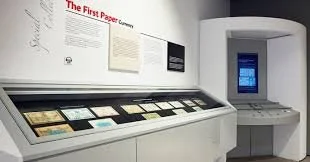
Monetary Authority of Singapore history gallery, courtesy of MAS
In 2021, the Monetary Authority of Singapore (MAS) honoured their 50th anniversary with a revamp of their gallery exhibition and the release of two books, one detailing the history of money in Singapore, and the other a compendium of key speeches and statements by MAS leaders, tracing the organisation’s politics and strategies in the past 50 years.
These projects show how history in corporate storytelling can be used in diverse ways, including but not limited to school programs, community engagement, and long-form publications like coffee table books to create unique and engaging experiences.
There are some challenges to be aware of, however, that come with the use of the past. Historical responsibility is key here. In an era where authenticity is scrutinised, organisations must balance marketing goals with historical accuracy. It is important not to avoid controversial histories such as complicated pasts, and to be wary of "lies by omission" or the creation of a corporate “myth”. Shying away from a complicated history can lead to a loss of consumer trust. Historical accuracy and ethical awareness are essential – a brand that acknowledges its past wrongs and addresses them builds deeper, more resilient bonds with its audience. Additionally, practical legal and ethical issues must also be considered, such as navigating copyright laws when using archival photographs.
Ultimately, the most successful corporate stories are those that embrace historical complexity. Organisations should not play with truth, as consumers value transparency. When handled with integrity and respect, these narratives serve as powerful tools for cultivating loyalty and a shared identity. By acknowledging the full scope of their journey, both triumphs and the challenges, corporations can move forward with a sense of purpose, using their history not just to look back, but to guide a responsible and successful future.
References
John T. Seaman Jr. and George David Smith, “Your Company’s History as a Leadership Tool,” Harvard Business Review (December 2012), https://hbr.org/2012/12/your-companys-history-as-a-leadership-tool
Oriol Iglesias, Nicholas Ind, Majken Schultz, “History matters: The role of history in corporate brand strategy,” Business Horizons 63:1 (2020), 51-60, https://doi.org/10.1016/j.bushor.2019.09.005.
Regany, F., Gorge, H. & Cailluet, L. “Whose History Is It Anyway? Uses and Abuses in the Co-Construction of Organizational Narratives,” J Bus Ethics (2025). https://doi.org/10.1007/s10551-025-06082-x.
Case Studies
Defence, Science & Technology Agency: https://www.dsta.gov.sg/whats-on/spotlight/the-media-vault
Temasek: https://www.temasek.com.sg/en/about-us/t50.
Monetary Authority of Singapore. https://www.mas.gov.sg/who-we-are/mas50